INTRODUCTION
The way people search for information online is changing rapidly. In the past, users primarily relied on Google to find websites, products, and services. Today, AI-powered platforms such as ChatGPT, Google AI Overviews, and Perplexity are changing how people discover information and make decisions.
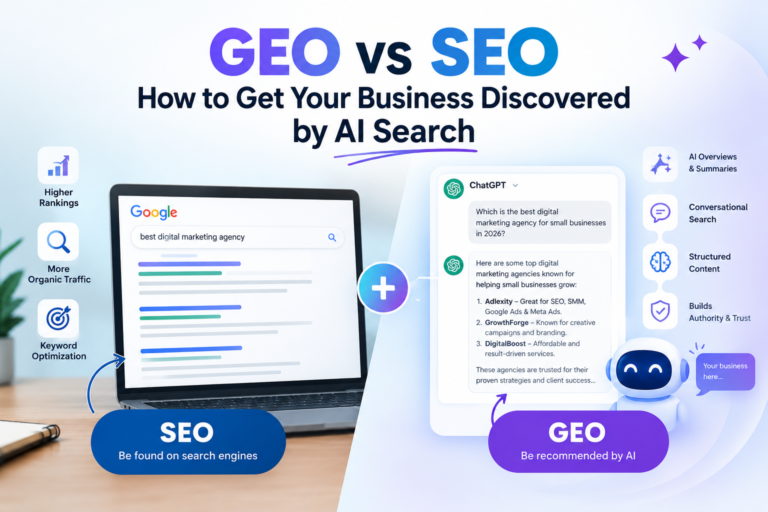
This shift has introduced two important digital marketing concepts: Search Engine Optimization (SEO) and Generative Engine Optimization (GEO). While SEO helps websites improve their visibility in traditional search engine results, GEO focuses on making a business’s content easier for AI-powered search tools to understand, reference, and recommend.
WHAT IS SEO [Search Engine Optimization]?
Search Engine Optimization, commonly known as SEO, is the process of improving a website to increase its visibility in organic search engine results. It helps businesses attract relevant visitors without paying for every click.
SEO focuses on several important areas, including keyword research, quality content, technical website performance, and backlinks.
What Is GEO (Generative Engine Optimization)?
Generative Engine Optimization, or GEO, is the practice of improving digital content so that AI-powered search and answer systems can understand it and potentially use it when generating responses.
Unlike traditional search engines that often present a list of website links, generative search tools may provide summarized answers using information from multiple sources.
GEO vs SEO: What Is the Difference?
Although GEO and SEO share many principles, their primary objectives differ.
SEO focuses on improving organic visibility in traditional search results, while GEO focuses on increasing the likelihood that a brand’s information will be understood, referenced, or mentioned in AI-generated responses.
Here are the main differences:
| Feature | SEO | GEO |
|---|---|---|
| Primary goal | Improve search engine rankings | Improve visibility in AI-generated answers |
| Main platforms | Google Search, Bing | ChatGPT, Perplexity, Google AI experiences |
| Content approach | Match search intent and provide value | Provide clear, contextual, and verifiable answers |
| Key signals | Relevance, links, technical health, content quality | Content clarity, relevance, credibility, and source accessibility |
| Desired outcome | Organic clicks and website traffic | AI mentions, citations, discovery, and potential referrals |
| Measurement | Rankings, impressions, clicks, conversions | AI referrals, citations, mentions, and conversions where measurable |
Why Is GEO Important for Business in2026?
Customers increasingly use conversational questions to research products, compare services, and find solutions. Instead of typing only short keywords, they may ask detailed questions and expect personalized answers.
This creates new opportunities for businesses to become visible during the customer research process.
GEO can help businesses:
Increase Brand Discovery: Make useful brand information accessible to AI-powered search systems.
Build Trust: Provide accurate answers that demonstrate knowledge and expertise.
Reach Relevant Audiences: Create content that addresses specific customer problems.
Strengthen Digital Presence: Improve consistency across websites and reputable online sources.
Support Customer Decisions: Explain services, benefits, pricing factors, and solutions clearly.
For agencies, restaurants, startups, and local businesses, being discoverable wherever potential customers search can become an important competitive advantage.
How to Optimize Your Website for GEO and SEO?
Research what your potential customers want to know before choosing a product or service. Use keyword research, customer feedback, and frequently asked questions to identify their needs.
For example, a digital marketing agency could create content around questions such as “How much does SEO cost?” or “How can restaurants attract customers through social media?”
2. Create Helpful, Original Content
Publish informative articles that solve real problems rather than simply repeating existing information. Include practical examples, accurate data, expert insights, and actionable recommendations wherever possible.
Content should be written for people first, not created solely to satisfy algorithms.
3. Structure Content Clearly
Use descriptive headings, short paragraphs, bullet points, and relevant FAQs. Begin important sections with direct answers before providing additional explanation.
Clear structure helps readers understand your content and can make information easier for search ystems to interpret.
Common GEO and SEO Mistakes to Avoid
Businesses should avoid keyword stuffing, publishing large volumes of low-quality AI-generated articles, using misleading statistics, and creating content without understanding user intent.
Another common mistake is treating GEO as a replacement for SEO. A technically weak website with inaccurate content may struggle to build trust regardless of how frequently it mentions AI-related keywords.
Focus on accuracy, originality, usability, and measurable business outcomes instead.
CONCLUSION
GEO and SEO are two important parts of a modern digital marketing strategy. SEO helps businesses improve their organic visibility, while GEO focuses on making their information more useful and accessible in AI-powered search experiences.
The best approach is not to choose one over the other. Businesses should build technically sound websites, publish high-quality content, answer customer questions clearly, and establish a credible online presence.
As search behavior continues to evolve, companies that adapt their content strategies to both traditional and AI-powered discovery will be better prepared to connect with potential customers.
Frequently Asked Question
Frequently
Asked Questions
SEO improves a website's visibility in traditional organic search results, while GEO focuses on improving the chances of being referenced or mentioned in AI-generated answers.
No. GEO complements SEO. Businesses should continue investing in technical SEO, useful content, and website quality while adapting to AI-powered search.
GEO can help businesses improve their discoverability in AI-powered search experiences, build brand awareness, and reach potential customers researching relevant products or services.
Yes. Small businesses can use GEO-friendly content to explain their services, answer customer questions, and improve their chances of being discovered through relevant AI search experiences.
Yes. Good SEO practices, including crawlability, quality content, clear site structure, and authoritative information, can support AI discovery. However, they do not guarantee AI mentions.