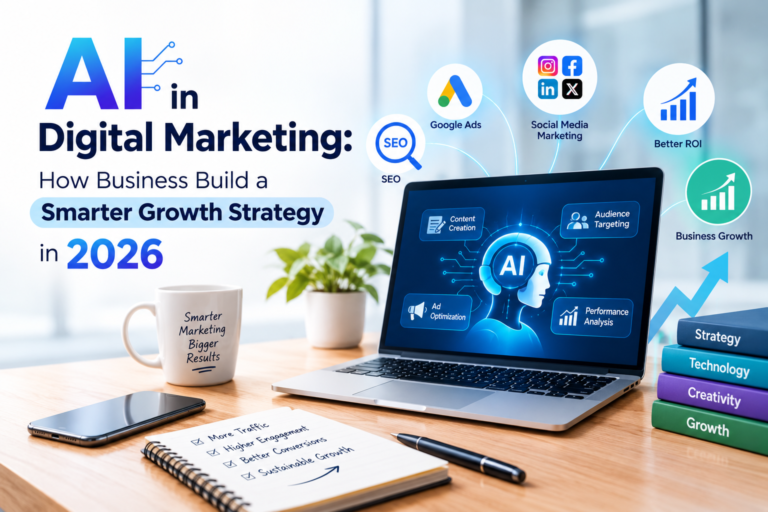
INTRODUCTION:- Digital marketing is changing faster than ever, and Artificial Intelligence (AI) is at the center of this transformation. In 2026, businesses are no longer using AI only for basic automation or content creation. AI is becoming an important part of how companies understand customers, create campaigns, optimize advertising, analyze data, and make marketing decisions. Search behavior is also becoming more conversational. AI-powered search experiences are changing how people discover information, products, and services. Google has introduced several AI-powered advertising and marketing capabilities in 2026, including AI Max, AI-powered creative tools, and AI-based marketing assistance.
What Is AI in Digital Marketing?
AI in digital marketing refers to using artificial intelligence technologies to perform tasks that traditionally require human analysis, creativity, or decision-making.
AI can help marketers:
Analyze customer behavior
Generate and optimize content
Identifypotential audiences
Personalize customer experiences
Improve SEO strategies
Optimize advertising campaigns
Predict customer trends
Automate repetitive marketing tasks
Measure campaign performance
Generate creative ideas and marketing assets
The goal is not to replace marketers. Instead, AI can help marketers spend less time on repetitive work and more time on strategy, creativity, and customer relationships.
Why AI Matters for Business Growth in 2026
Customer journeys are becoming more complex. People may discover a business through search, social media, video, advertisements, reviews, AI-powered search results, or recommendations before making a decision.
AI helps businesses understand these different interactions and use data more effectively.
Google’s 2026 marketing developments show this shift clearly, with AI being integrated into Search, advertising, creative production, measurement, and marketing assistance.
A smart AI-driven strategy can help businesses:
Save Time: Automate repetitive marketing activities.
Improve Targeting: Understand customer interests and behavior more effectively.
Personalize Marketing: Deliver more relevant messages to different customer groups.
Optimize Advertising: Use AI-powered systems to identify opportunities and improve campaign performance.
Make Better Decisions: Turn marketing data into actionable insights.
.
1. AI-Powered SEO
SEO is changing as search becomes more conversational and AI-powered.
Instead of searching only short keywords, users increasingly ask detailed questions and expect useful answers. Businesses therefore need content that clearly answers customer questions and demonstrates genuine expertise.
AI can support SEO by helping marketers:
Discover relevant search topics
Analyze search intent
Identify content gaps
Create content outlines
Improve existing content
Organize keyword research
Analyze competitors
Find internal linking opportunities
2. Smarter Content Marketing
Content remains one of the strongest tools for building brand awareness and customer trust.
AI can make content production more efficient by helping marketers generate:
Blog ideas
Social media concepts
Email campaigns
Ad copy
Video scripts
Headlines
Product descriptions
Content variations
3. AI-Powered Google Ads
Paid advertising is another area where AI is becoming increasingly important.
AI-powered advertising systems can analyze signals such as customer intent, campaign performance, website information, and audience behavior to help businesses reach relevant users.
Discover new opportunities
Improve ad relevance
Generate creative variations
Optimize campaigns
Reach potential customers
Analyze performance
Improve conversion strategies
5. AI for Social Media Marketing
Social media teams often have to manage multiple platforms, content formats, audiences, and campaigns.
AI can help marketers with:
Content ideas
Caption creation
Content calendars
Audience analysis
Trend research
Creative variations
Performance analysis
Campaign optimization
6. AI-Powered Analytics and Decision-Making
One of the biggest advantages of AI is its ability to process large amounts of marketing data.
Instead of looking at dozens of separate reports, marketers can use AI-assisted tools to identify patterns and opportunities.
Businesses can analyze:
Website traffic
Conversion rates
Customer acquisition cost
Advertising performance
Engagement
Customer behavior
Revenue trends
Campaign performance
7. AI Chatbots and Customer Support
AI-powered chatbots can help businesses respond to common customer questions quickly.
They can assist with:
Frequently asked questions
Product information
Service details
Basic customer queries
Lead qualification
Appointment-related questions
Initial customer support
CONCLUSION
AI is transforming digital marketing in 2026 by helping businesses work smarter and make faster, data-driven decisions. From SEO and content creation to advertising, personalization, analytics, and customer support, AI can improve almost every stage of the digital marketing journey.
However, successful AI marketing is not about replacing humans. It is about combining AI efficiency with human creativity, strategic thinking, and authentic customer understanding.
Businesses that start with clear goals, use reliable data, maintain human oversight, and continuously measure their results can build a smarter and more sustainable growth strategy for the future.
Frequently Asked Question
Frequently
Asked Questions
AI in digital marketing means using artificial intelligence to analyze data, automate tasks, personalize experiences, create content, and optimize marketing campaigns.
AI can help businesses understand customers, improve advertising, personalize marketing, automate repetitive tasks, and identify new growth opportunities.
No. AI can automate many tasks, but human creativity, strategic thinking, communication, and decision-making remain important.
AI can assist with search-intent analysis, topic research, content optimization, competitor analysis, and identifying content opportunities.
Yes. AI can help create blog ideas, social media posts, ad copy, email drafts, product descriptions, and other marketing conte